
Three Masters’ Boards hang in the Small Hall. Between them they give a continuous list of the Masters of the Company of Merchant Taylors from 1641 to the present day.
The Board listing the Masters from 1700 was prepared in 1890, with names added up to 1900, and a matching Board was made in 1901 for the Masters since then. The pair are beautifully illuminated with intricate artwork by Henry C Camidge, whose name appears in tiny print on each Board as the ‘Illuminator’, with the date it was prepared.
Michael Mennim’s history of the Company tells how it came about. At first the Court agreed that a roll of the Masters, going back as far as possible, should be painted on board and hung in the Hall. When the estimate of £13 12s 6d arrived, the idea was put off until the accounts had been audited and the Company’s £100 loan was settled. Over the months the plans grew grander, until an illuminated roll was painted. As Mennim puts it, ‘the Company’s function as a patron of the Arts surfaced again’. On top of Mr Camidge’s charge of seven guineas, he was presented with an extra guinea for his excellent work.
The finished Roll was shown at the Company’s Michaelmas Dinner at the Old George Hotel, Pavement, in October 1892. The Yorkshire Herald described it as ‘richly illuminated’, with the Merchant Taylors’ arms at the top, the arms of King Charles II, who granted the Charter of Incorporation, at the foot, the arms of the City and the See of York at the sides, and the White Rose of York in the corners. It was framed by Mr John Sampson of York in ‘a massive antique oak frame and a gilt oak flat’, and was much admired.
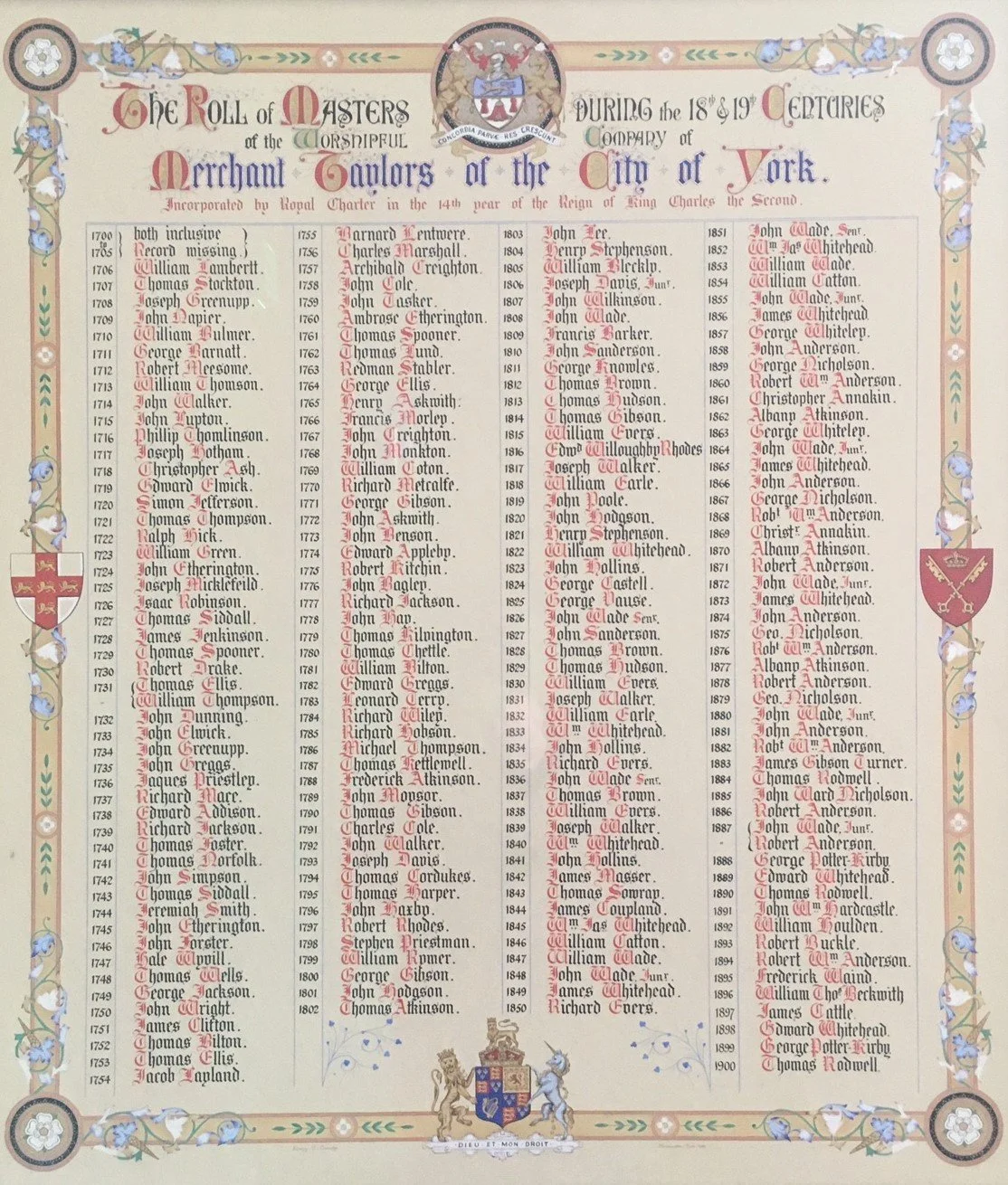
By 2004 both Boards were in a poor state of repair, so they were replaced with high-quality photographs of the originals by Art-to-Art Reproductions, printed on board and mounted in the original frames. The original Boards are held at the Borthwick Institute as part of the Company’s archives.
Curiously, the Boards refer to ‘the Worshipful Company of Merchant Taylors’. The Master is called the ‘Worshipful Master’ in some Court minutes of the time, but the word ‘Worshipful’ doesn’t seem to appear in other documents. Was it an error, or did the Company have aspirations? The arms at the top of the two Boards are those of the London Company of Merchant Taylors, as the York Company did not have its own arms until 1963.
The 1901 Board is now brought up to date every three years, most recently in 2022, by Wood Richardson, printers in York, who hold the artwork on disk, add the new names in an ‘Old English’ font and reprint it for framing.
In 1903 a third Board was made, listing the Masters from 1641 to 1706. Its design is simpler, as the Court decided it should suit the period it covered. It came about because the Company’s lost Minute Books for 1641–80 and 1680–1706 had been found in the Guildhall in 1901.
Two years later, in 1905, a framed board in a similar style was made, setting out the cost of obtaining the Royal Charter of Incorporation granted by King Charles II on 26 April 1662. It was presented by George Potter-Kirby JP, Sheriff of York in 1901–2 and Master in 1888–9 and 1899–1900, and, like the 1641 Board, prepared by H C Camidge. It also records a minute of 9 December 1665: ‘Lastly that Mr Henry Rirson have nothing allowed for his paines for going to London to get the Charter – but thanks.’
Researched and written by Graham Wilford (GAW).
Part of The Wilford Archive. Read more about the history of the Hall, or arrange a viewing to see the Hall for yourself.